

• A
  • A
  • A
  • ABC
  • ABC
  • ABC
  • А
  • А
  • А
  • А
  • А
Regular version of the site
Book chapter
Participles, auxiliaries and the insertion approaches to verbal periphrasis
In press

Rudnev, Pavel.

In bk.: Theoretical Issues in the Languages of the Caucasus. Amsterdam: John Benjamins, 2026. Ch. 7. P. 212-236.

Working paper
An Annotation Scheme and Classifier for Personal Facts in Dialogue
In press

Zaitsev K.

arxiv.org. Computer Science. Cornell University, 2026

Research & Expertise – News

HSE Researchers Compare Expressive and Receptive Language Abilities of Russian-speaking Children with ASD for the First Time

HSE Researchers Compare Expressive and Receptive Language Abilities of Russian-speaking Children with ASD for the First Time
Researchers from the HSE Centre for Language and Brain and their Russian and American colleagues have become the first to compare expressive and receptive language abilities of Russian children with Autism Spectrum Disorder (ASD) at different linguistic levels. Their work helped them refute the hypothesis that children with ASD understand spoken language less well than they produce it. The study was published in Research in Developmental Disabilities.

Reformatting Research Activity: First Large-Scale Projects Launched at HSE University

Faculty of Humanities
Less than a year ago, the Faculty of Humanities at HSE University launched four large-scale projects, bringing together representatives of different disciplines from different departments and campuses of the University. Their goals, content, staffing and expected results were presented at a meeting of the Rector’s Council. Other departments have been tasked with developing their own large-scale projects, which HSE University will be able to include in its application for the ‘Priority 2030’ programme.

Predicting Grammatical Properties of Words Helps Us Read Faster

Predicting Grammatical Properties of Words Helps Us Read Faster
Psycholinguists from the HSE Centre for Language and Brain found that when reading, people are not only able to predict specific words, but also words’ grammatical properties, which helps them to read faster. Researchers have also discovered that predictability of words and grammatical features can be successfully modelled with the use of neural networks. The study was published in the journal PLOS ONE.

HSE Scholars to Participate in Creating a New Platform for Russian National Corpus

HSE Scholars to Participate in Creating a New Platform for Russian National Corpus
The Russian Ministry of Education and Science has announced the results of a grant competition for big research projects. One of the winners is a project with HSE University participation: the creation of a next generation computational linguistic platform to digitally record the Russian language.

Lingtypology – the package for linguistic mapping and typology – is four years old.

Photo by Slava Zamyslov
Until four years ago there was no simple tool for linguists to mark a set of points on a map with different colors. A point corresponded to a language, and its color corresponded to a linguistic feature of the language. This inspired George Moroz, of HSE’s Linguistic Convergence Laboratory and School of Linguistics, to create a new software product that turned out to be very popular: lingtypology.

Language Science Press has published a book on the Mehweb language

Language Science Press has published a book on the Mehweb language
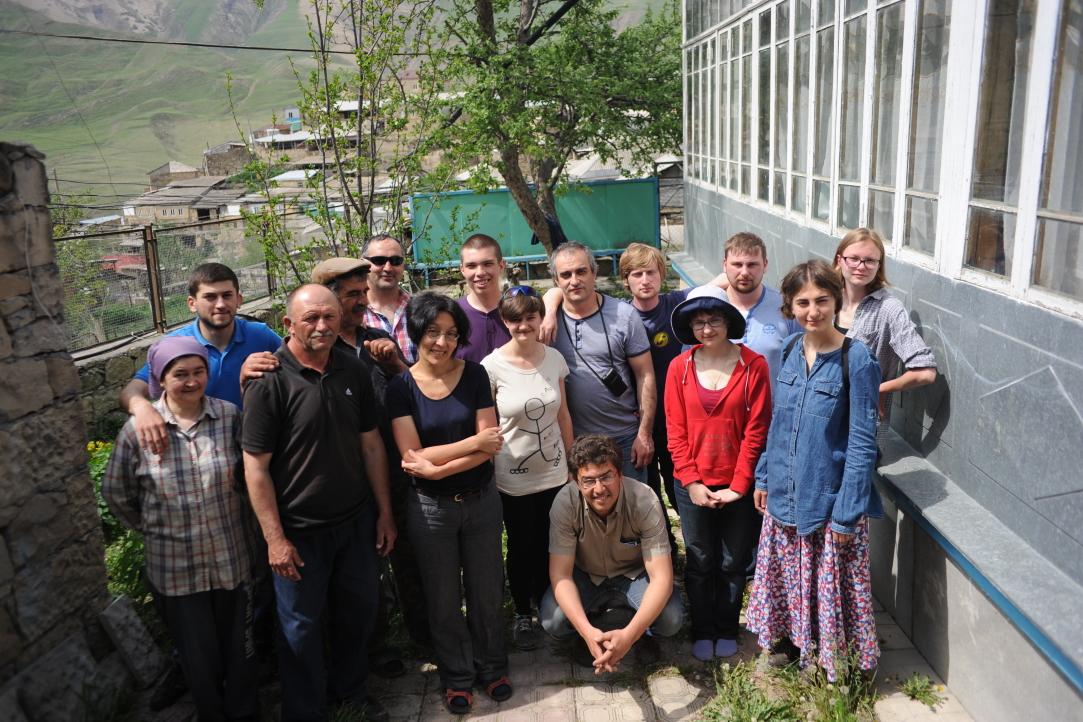
Language Science Press has published a book on the Mehweb language, edited by Michael Daniel and Nina Dobrushina of the Linguistic Convergence Laboratory and Dmitry Ganenkov of the Laboratory of Caucasian languages.

‘We Have Not Yet Fully Understood How Languages ​​Work, and We Are Already Losing 90% of Their Diversity’

‘We Have Not Yet Fully Understood How Languages ​​Work, and We Are Already Losing 90% of Their Diversity’
Why might a grandmother and her grandson not understand each other? Why would linguists want to go to Dagestan? Is it possible to save the less commonly spoken languages of small nations and Russian dialects? Nina Dobrushina, Head of the Linguistic Convergence Laboratory answered these questions in an interview with HSE News Service.

Digital Humanities: A God of Many Faces

Gimena del Rio Riande
These days, no scientific research is carried out without the use of digital media for the production or dissemination of knowledge. The term ‘Digital Humanities’ reflects this process and constitutes a scientific field where humanists not only aim to use a certain software, but also to understand research using quantitative semantics. However, digital infrastructures are not the same globally. In her talk at the HSE April International Academic Conference Dr Gimena del Rio Riande addressed various issues that arise in connection with digital humanities.

‘Our Students Were Able to See that HSE is a Real Research University’

Tilmann Reuther, Professor at the University of Klagenfurt, and his colleague Joulia Köstenbaumer talk to the HSE News Service about their experience of cooperation with the School of Linguistics and internships in Austria.

Conference ‘Corpus Technologies, Digital Humanities and Modern Research’ Held at HSE Nizhny Novgorod

Conference ‘Corpus Technologies, Digital Humanities and Modern Research’ Held at HSE Nizhny Novgorod
Today computer and corpora technologies play an important role in language studies and language learning along with traditional methods of analysis. New corpora resources and software for language analysis are regularly developed. Experts from Russia, CIS and other countries discussed the latest achievements in this field at the international conference ‘Corpus Technologies, Digital Humanities and Modern Research’.